I’m Tessa, twenty-seven years old, and my childhood was shaped by silence, resentment, and a kind of emotional distance that never really healed. My mother, Linda, had me when she was just eighteen, and from my earliest memories she made sure I understood that my existence had cost her everything—her youth, her dreams, her freedom. She used to say my father left because he “couldn’t handle responsibility,” but as I grew older, the story subtly shifted until the blame landed squarely on me. Our home never felt warm; love was conditional, and affection was rare. Still, despite everything, she was my mother, and there was a stubborn part of my heart that kept hoping she might one day choose me. That hope carried me into adulthood, even into my marriage to Adam, a man who felt like the exact opposite of the chaos I grew up with—steady, kind, thoughtful. With him, I finally believed I had built a life that was safe, loving, and entirely my own.
That illusion shattered on an ordinary Tuesday, the kind of day that should have meant nothing at all. Adam was in the shower, and his phone buzzed on the nightstand. I glanced at it without thinking, expecting a work message or a reminder notification. Instead, I saw a heart emoji next to the name “L❤️,” and a message that made my stomach drop: “Honey, I can’t wait to see you tomorrow. Just lie to my daughter—she’ll believe anything you say.” I remember the room spinning, my hands going cold, my breath caught somewhere in my chest. When I confronted Adam, he didn’t even try to deny it. He said he loved her, said age didn’t matter, said it all in the same calm voice he used to comfort me when I was upset. My mother didn’t cry or apologize either. She looked at me with a chilling detachment and told me not to be selfish, that love wasn’t something you could control. In that moment, I realized I had lost both a husband and a mother in the same breath.
The divorce was quick and devastating. I cut off contact completely, not out of spite, but out of self-preservation. I had to rebuild myself from the wreckage they left behind. Then, months later, the announcement came: Linda and Adam were getting married. Some relatives had the audacity to tell me I should support her, that “family is family,” as if betrayal could be erased with platitudes. I didn’t go. On the day of their wedding, I stayed home wrapped in blankets, staring at the wall, trying to survive the day without breaking. That’s when my phone rang. It was my cousin Sophie, the only one who had stood by me without excuses or conditions. Her voice was shaking, barely contained with urgency and disbelief. “Tessa,” she said, “you won’t believe what’s happening here. Take a taxi and come right now. You cannot miss this.”
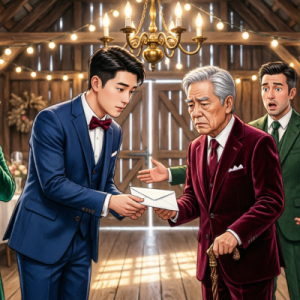
When I arrived at the ceremony, the atmosphere was chaos disguised as celebration. Guests were whispering, the officiant stood frozen, and my mother’s face had gone pale. Sophie grabbed my hand and told me everything in rushed fragments: someone had come forward—an old friend of my mother’s—with proof that Linda had lied for years about my father, about her past, about the very story she built her victimhood on. Documents, messages, and witnesses revealed that she had manipulated situations, destroyed relationships, and even pursued Adam deliberately, knowing exactly who he was to me. The truth spread through the room like fire. Guests walked out. Adam stood there humiliated, realizing he hadn’t fallen into a grand romance but into a pattern of manipulation. The wedding collapsed in real time, their smiles replaced by shock and shame. I didn’t say a word. I didn’t need to. For the first time in my life, the truth spoke louder than I ever could—and the people who betrayed me finally faced the brutal cost of their choices.